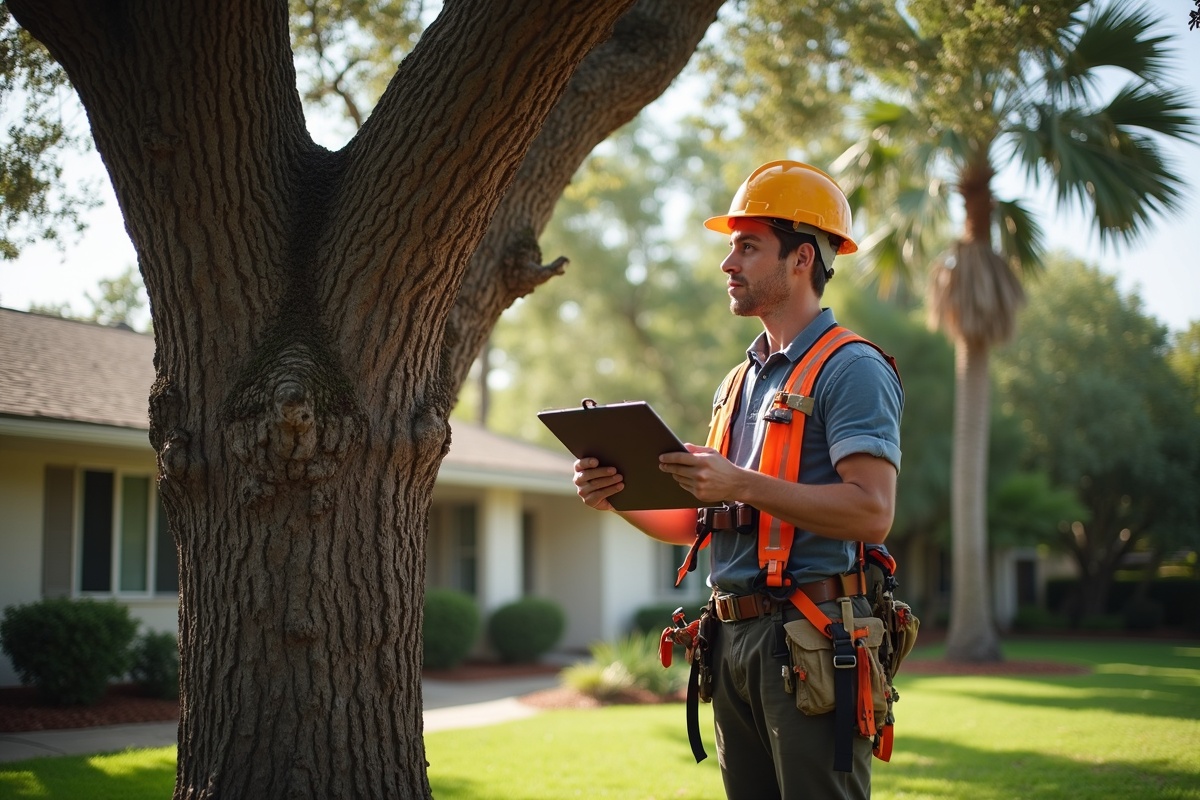
Do You Need a Permit to Remove a Tree in Gulf Breeze, FL?
Before you schedule a tree removal in Gulf Breeze or anywhere in Santa Rosa County, it’s worth knowing whether a permit is required. Florida’s tree regulations come in layers — state law, county ordinances, municipal rules, and HOA covenants — and they don’t always agree with each other. Getting it wrong can mean fines, required replanting, or worse.
The short version: many private residential tree removals in the Gulf Breeze area don’t require a permit, but there are important exceptions — and Florida’s protected-species rules, the City of Gulf Breeze tree ordinance, and HOA requirements add complexity worth understanding before you proceed.
Tree Removal on Private Property: The Baseline
For trees located entirely on private residential or commercial property in unincorporated Santa Rosa County — not in a right-of-way, not part of a development permit — county regulations generally don’t require a permit to remove an individual tree. Property owners have broad rights to manage vegetation on their own land.
But that baseline has meaningful exceptions, and the rules differ depending on whether your property is inside the City of Gulf Breeze limits (32561) or in the unincorporated 32563 corridor (Tiger Point, Oriole Beach, Woodlawn Beach, Midway).
City of Gulf Breeze Tree Ordinance
The City of Gulf Breeze — which prides itself on its “City of Trees” identity and its live oak canopy — has a tree protection ordinance that is more restrictive than the county baseline. Key provisions that affect homeowners:
Protected and heritage trees. Gulf Breeze has provisions protecting significant trees above certain size thresholds, and live oaks in particular carry strong protections given their role in the city’s canopy. A tree that qualifies as protected under city ordinance may require a permit and specific justification to remove, even on private property. Size thresholds and species designations matter here; contact the City of Gulf Breeze Community Development or Planning Department for current rules, as ordinances change.
Development and land-clearing activities. If you’re removing trees as part of a construction project, a renovation requiring a building permit, or any land-clearing, the city’s tree mitigation requirements may apply. These can require accounting for removed trees and may require replacement planting or a payment into a tree fund.
Right-of-way trees. Trees in the public right-of-way are city property — see that section below.
When in doubt, call the City of Gulf Breeze before removing any tree that might qualify as protected by size or that’s part of a development project. A quick call is far cheaper than a violation.
Unincorporated Santa Rosa County (the 32563 Corridor)
For properties outside city limits — much of Tiger Point, Oriole Beach, Woodlawn Beach, and Midway — tree removal is administered by Santa Rosa County. The county’s land development code includes tree preservation requirements that apply particularly to:
- Significant development projects and land clearing
- Protected species (see below)
- Properties within environmentally sensitive areas (wetlands, coastal zones, floodplains — common along the Santa Rosa Sound shoreline)
For a routine single-tree removal on a standard residential lot in the unincorporated corridor, permits are typically not required — but this depends on the specifics, including species and size. For guidance, contact Santa Rosa County’s planning or development services office.
Florida’s Protected Tree Species: Sabal Palms, Live Oaks, and More
Florida state law and local regulations protect certain species and habitat types worth understanding:
Sabal Palm (Sabal palmetto): Florida’s state tree has specific legal protections in some contexts. Local ordinances and state rules may affect removal, especially in certain zones. Verify current rules before removing sabal palms.
Live Oaks: Mature live oaks may trigger protected or heritage-tree provisions under the City of Gulf Breeze ordinance, depending on size and location. Given the area’s identity around its oak canopy, these trees are often subject to more protective rules than other species.
Trees in Wetlands and Coastal Uplands: If your property contains wetlands, or sits in a coastal high-hazard area or floodplain — common on Sound-front lots in Villa Venyce, Santa Rosa Shores, and the 32563 corridor — removal near those areas may trigger Florida Department of Environmental Protection review or Army Corps of Engineers coordination, on top of local permits.
Longleaf Pine habitat: Longleaf pine sandhill ecosystems are protected under various state and federal programs. If your property contains significant longleaf habitat, check with the county before large-scale removal.
When in doubt about species-specific protections, contact the Florida Forest Service or the applicable county or city agency before proceeding.
Trees in the Public Right-of-Way
This is the most common source of removal complications. The public right-of-way is the strip between the property line and the street — typically containing the sidewalk, utility easements, and the “tree lawn.” This land is publicly owned or controlled, not private property, even though adjacent homeowners often maintain it.
If a tree sits in the public right-of-way:
- You cannot remove it without authorization from the City of Gulf Breeze or Santa Rosa County (depending on whose right-of-way it is)
- If the tree is dead, diseased, or a safety hazard, report it to the applicable agency and they’ll evaluate it
- Unauthorized removal of a right-of-way tree can bring fines and a requirement to replant at your cost
Don’t assume a tree on “your side” of the sidewalk is yours. Verify the right-of-way boundary before any removal near the street.
HOA Rules and Tree Removal
Many Gulf Breeze-area neighborhoods — including the Tiger Point subdivisions (Champions Green, Sawgrass, Tiger Lake, Willow Wood) and various Sound-front communities — are HOA-governed, and their CC&Rs or architectural guidelines may regulate tree removal on your own lot.
Common HOA tree provisions include:
- Approval required before removing any tree over a certain trunk diameter (often 4 or 6 inches)
- Front-yard or street-facing trees protected for neighborhood aesthetics
- Required replacement planting when a significant tree is removed
- Prohibition on topping (a good provision some HOAs have adopted)
Rules vary community to community. To find yours:
1. Locate your HOA’s CC&Rs (usually provided at closing; also available from your management company)
2. Look for sections on landscaping, trees, or architectural guidelines
3. If Architectural Review Committee approval is required, submit a request before scheduling removal
Violating HOA landscaping rules can bring fines, liens, and a demand to restore the landscape at your expense. A 15-minute review of your CC&Rs before calling a tree service is worthwhile.
Utility Easements and Florida “Call Before You Dig”
Many Santa Rosa County properties have recorded utility easements where power, water, sewer, gas, or telecom companies have access rights. Trees growing in or over easements may be trimmed or removed by the utility at their discretion.
Before any tree removal involving ground disturbance (including stump grinding):
- Call 811 (Florida’s Sunshine State One Call service) at least two business days before the work
- This is required by Florida law and protects you from liability if underground utilities are damaged
- The service is free
This matters especially for stump grinding, where the equipment penetrates below grade.
Trees on Neighboring Property
If a neighbor’s tree has branches or roots encroaching on your property, Florida law generally lets you trim branches and roots up to your property line — but you can’t enter the neighbor’s property to do so, and you can’t remove the tree.
If a neighbor’s tree appears dead, diseased, or at high risk of falling onto your property, start with a direct conversation. If the tree is genuinely dangerous and the neighbor is unresponsive, a written notice (keep a copy) documents your concern. For serious hazards, a consultation with a Florida property attorney may be warranted.
Tree companies can’t work on a neighbor’s tree without the owner’s authorization, regardless of the tree’s condition.
Trees and Insurance Claims in Florida
If a tree falls and damages your property, documentation is critical. Before any cleanup after a storm or failure:
1. Photograph everything — the fallen tree, the damage, and any context (rot, previous lean)
2. Contact your homeowners insurance carrier before cleanup starts
3. Get a written estimate from any tree company you hire — you’ll need it for the claim
4. Ask the tree company for documentation of the work performed
Florida’s homeowners insurance market is complex — policies differ significantly in windstorm coverage, hurricane deductibles, and how they handle tree removal. Know your policy before assuming coverage.
Summary: Permit Requirements for Tree Removal in Gulf Breeze
| Situation | Permit Required? |
|—|—|
| Tree on private residential property, not in ROW | Generally no — verify city/county ordinance and HOA rules |
| Protected/heritage tree (City of Gulf Breeze) | May require city permit — contact Community Development |
| Tree in public right-of-way | Yes — contact City of Gulf Breeze or Santa Rosa County |
| Tree removal as part of development/land clearing | Subject to local tree mitigation requirements |
| Sabal palms or protected species | Verify with county/state before removal |
| HOA-governed property (Tiger Point, etc.) | Check CC&Rs — committee approval may be required |
When in doubt, a phone call to the City of Gulf Breeze or Santa Rosa County takes 10–15 minutes and protects you from an expensive mistake.
Questions? We Can Help
Gulf Breeze Tree Pros has extensive experience with Santa Rosa County property owners, city right-of-way situations, and HOA requirements. We can help you understand what’s likely to apply and point you to the right contacts — though for definitive permit guidance, the city, county, or your HOA is always the authoritative source.
Call (801) 860-6906 for questions or to schedule a free tree removal estimate.
Back to Tree Removal Services →
*Related reading:*
- *How Much Does Tree Removal Cost in Gulf Breeze? →*
- *Signs a Live Oak or Pine Is a Storm Hazard →*
- *Contact Us for a Free Estimate →*
*Note: This article provides general information about tree removal permitting in Gulf Breeze and Santa Rosa County, Florida based on publicly available information as of 2026. Local ordinances and HOA rules change. Always verify current requirements directly with the City of Gulf Breeze, Santa Rosa County, or your HOA before proceeding. This is not legal advice.*
Get a Free Tree Service Quote
Fill out the form below or call (801) 860-6906. We respond fast.
Leave a Reply